Projects
Individual Development
To the project browser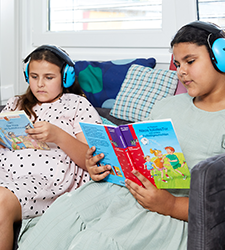
TROCHEE
The DFG Project TROCHEE is investigating how primary school students perceive and produce trochaic patterns within words while reading. A combined longitudinal and cross-sectional study design allows for insight into prosody at the word level, as well as the analysis of further reading-related factors. The aim of the project is to better understand the role of word-level prosody in the context of reading development.
BRISE-Interaction Quality
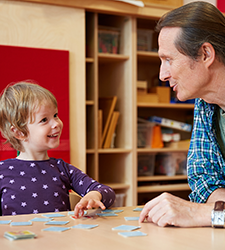
The sub-project “BRISE Interaction Quality” examines how support from the family and preschools affects children’s development.
SprachFit
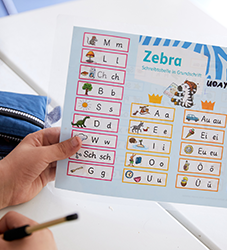
The acquisition of language skills is essential for overall child development. The “SprachFit” initiative aims to identify language deficits in children at an early stage and provide targeted support. The accompanying scientific evaluation study examines the implementation of the initiative and its impact on child development.
Startchancen SRL
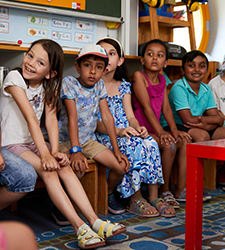
As part of the scientific research accompanying the Startchancen programme, we are investigating how self-regulated learning can be promoted – especially among children from socially disadvantaged backgrounds.
MultiDynAssess-India
The project designs, implements, and evaluates multilingual dynamic assessment (DA) in Indian primary government schools where English is taught in a context characterised by high sociolinguistic diversity and widespread code-mixing practices. It investigates how multilingual versus English-only DA affects Grade 4 students’ language and content learning over time, drawing on classroom observations and a longitudinal comparison with traditional static assessment in schools in New Delhi and Guwahati. By aligning assessment with learners’ full linguistic repertoires, the project aims to promote equity in education and offers implications for multilingual assessment practices in India and other linguistically diverse contexts in the Global South.
CHAT2TRANSITION
The project examines the emergence and consequences of educational decisions at the transition from primary to secondary school. It focuses on improving the information available to families and teachers. A multilingual chat assistant for families and a reflection program for teachers aim to reduce social and migration-related inequalities in educational outcomes.
BRISE-School Readiness
The sub-project of the second project phase (2025–2029) at DIPF is dedicated to the effects of the early childhood support chain on the development of basic skills in reading, spelling and arithmetic over the course of the primary school years.
MaLeLiOS
The MaLeLiOS project aims to investigate how narratively designed mathematical learning situations encourage children to engage in mathematical conversations and thus enable them to listen and observe on the one hand and to talk about mathematics and mathematical activities on the other.
Young Children’s Worlds
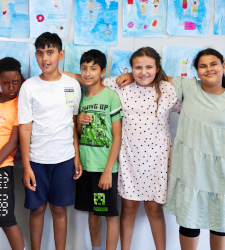
This project will develop a questionnaire to quantitatively assess the well-being of children between the ages of 6 and 8. The study will be conducted in parallel in South Africa and Israel.

TAM
The aim is to investigate the developmental trajectories of cognitive and motor adaptation across childhood, adolescence, young adulthood and old age. We have developed a new task that has proven to be appropriate and sensitive for investigating developmental and individual differences within specific age groups.