Projects

MotivO
Project MotivO aims at investigating and comparing motivational aspects of reading achievement across orthographies (German vs. Hebrew). Within the context of a cooperation project, German and Israeli 2nd and 4th Graders will be compared regarding their reading motivation and reading achievement in a cross-language research design to detect positive or negative feelings towards reading as well as changes across time.

MuKi
Investigating emotional expectation and appraisal processes in children aged 8-12
MultiDiskurs
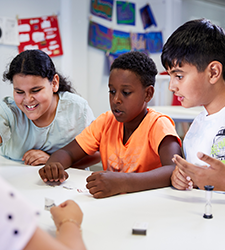
The project aims to account for patterns of variation in the processing of linguistic structures in discourse. In particular, we investigate how bilingual children ranging in age from 8 to 12 integrate morphosyntactic and discourse information, for example by using eye-tracking experiments. Among the factors that contribute to individual variation, we explore the role of cross-linguistic influence, differences in bilingual profiles in terms of language and literacy exposure, individual cognitive skills and bilinguals’ ability to share discourse strategies across their two languages.
MultiDynAssess-India
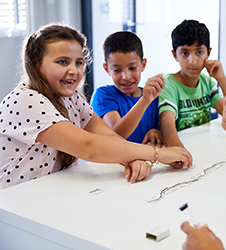
The project designs, implements, and evaluates multilingual dynamic assessment (DA) in Indian primary government schools where English is taught in a context characterised by high sociolinguistic diversity and widespread code-mixing practices. It investigates how multilingual versus English-only DA affects Grade 4 students’ language and content learning over time, drawing on classroom observations and a longitudinal comparison with traditional static assessment in schools in New Delhi and Guwahati. By aligning assessment with learners’ full linguistic repertoires, the project aims to promote equity in education and offers implications for multilingual assessment practices in India and other linguistically diverse contexts in the Global South.

NawiSelf*digital
The aim of the project is to investigate the effectiveness of teaching units for primary school science that integrate the use of digital media.

NEDA
The project NEDA investigates the relationship between the development of reading and spelling skills and the development of neural auditory processing in elementary school children.

NEDIK
Children, like adults, often have difficulty processing linguistic negation. However, these difficulties can be reduced or even eliminated when negation is presented in an appropriate context. Our project therefore examines how different contextual factors affect children’s processing and production of negation, with the aim of identifying the specific factors that facilitate these processes.

NEIS
Project NEIS is concerned with the development of self-regulatory skills – the ability to perform goal-oriented behavior – in children aged between 5 and 8 years.

NeO
The discussion regarding “more male nurses in kindergardens” is currently present internationally. The public discussion involves multiple attributes for girls and boys as well as for their female and male nurses. The NeO Project sheds light on the nurses’ perspectives regarding the meaning of gender within early childhood education.

NEPCO
Children have difficulty understanding negation until around the age of five or six, and even adults process negative sentences less efficiently than affirmative ones. This project investigates whether these difficulties are related to the development of children’s cognitive abilities. To address this question, German-speaking children aged four to ten years and adult control participants will be tested using comprehension tasks, sentence-completion tasks, and eye-tracking experiments.