Projects
Individual Development
To the project browser
SeLFi-Panel-Study
The SeLFI Panel Study examines the development of self-regulation among students in grades 1 to 10. It focuses on links with reading and mathematics skills as well as mental health. In the long term, the study aims to provide instruments and normative data to support teachers in assessing self-regulation.

ProFix
Some students read literary texts as if they were expository texts: limiting themselves to extracting bits of information, without immersing themselves into textworlds or responding affectively or aesthetically to the texts. We call this a “limitation to the propositional textbase”. In our ProFix study, we are working with 400 students from Germany and Switzerland and try to understand who is afflicted by this phenomenon.
Ko-divers
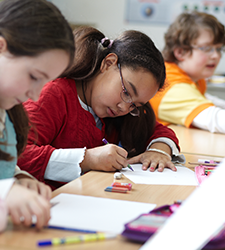
The Ko-divers project aims to develop through an evaluation-based process, a practical, effective and diversity-sensitive teaching concept for cooperative learning using the design-based research approach within research-practice partnerships.
BRISE-Interaction Quality
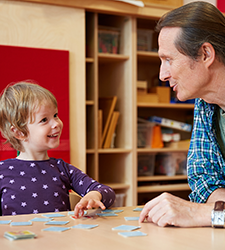
The sub-project “BRISE Interaction Quality” examines how support from the family and preschools affects children’s development.
Startchancen SRL
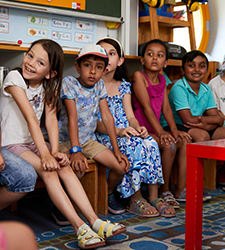
As part of the scientific research accompanying the Startchancen programme, we are investigating how self-regulated learning can be promoted – especially among children from socially disadvantaged backgrounds.
MultiDynAssess-India
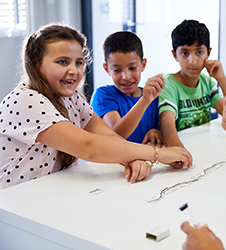
The project designs, implements, and evaluates multilingual dynamic assessment (DA) in Indian primary government schools where English is taught in a context characterised by high sociolinguistic diversity and widespread code-mixing practices. It investigates how multilingual versus English-only DA affects Grade 4 students’ language and content learning over time, drawing on classroom observations and a longitudinal comparison with traditional static assessment in schools in New Delhi and Guwahati. By aligning assessment with learners’ full linguistic repertoires, the project aims to promote equity in education and offers implications for multilingual assessment practices in India and other linguistically diverse contexts in the Global South.
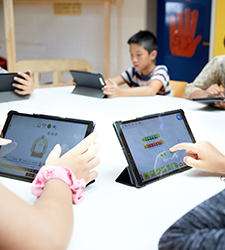
CatMo – Arena
Category learning tasks are experimental paradigms used to study how humans acquire and apply categorical knowledge. Participants learn to classify multi-feature stimuli into categories without being explicitly told the underlying rules. Performance in these tasks provides insight into processes of generalization, abstraction, and memory.
MultiDiskurs
The project aims to account for patterns of variation in the processing of linguistic structures in discourse. In particular, we investigate how bilingual children ranging in age from 8 to 12 integrate morphosyntactic and discourse information, for example by using eye-tracking experiments. Among the factors that contribute to individual variation, we explore the role of cross-linguistic influence, differences in bilingual profiles in terms of language and literacy exposure, individual cognitive skills and bilinguals’ ability to share discourse strategies across their two languages.
CHAT2TRANSITION
The project examines the emergence and consequences of educational decisions at the transition from primary to secondary school. It focuses on improving the information available to families and teachers. A multilingual chat assistant for families and a reflection program for teachers aim to reduce social and migration-related inequalities in educational outcomes.

MoMoView
The aim of the project is to investigate individual differences in visual perception and memory for scenes, in particular how people of different ages remember previously viewed scenes and how gaze patterns differ between viewing and recalling scenes.