Projects
Adaptive Education
This domain focuses on learning arrangements in kindergarten, school, and informal educational settings.
To the project browser
Ada*Q
The research project “Adaptivity and teaching quality in individualized lessons” (Ada*Q) is part of the Robert Bosch Foundation’s “How does a good school work? – Research for practice” programme. The project investigates how individualized teaching in elementary school is implemented and designed at the schools that have won the German School Award.
AppLeMat
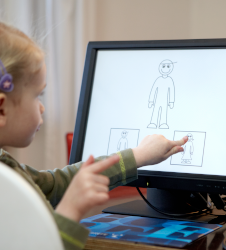
The AppLeMat project aims to develop and evaluate a therapeutic, tablet-based application as an adjunct to learning therapy.
BiLTex
The IDeA project BiLTex investigates potential differences between bilingual and monolingual learning environments for text comprehension. Whereas in monolingual learning environments all information and actions are available or take place in German, in bilingual learning environments the mother tongue is systematically included. BilTex aims to investigate whether the inclusion of the language of origin has a positive effect on text comprehension and the learning experience of pupils growing up bilingually.
BiPeer
BiPeer explores ways to support German reading competency of Turkish-German bilingual primary school children using peer-learning methods.
BiPra-Text
The project compares monolingual and bilingual learning environments for multilingual pupils in fourth and fifth grade in German-English bilingual schools.
CA:PPA-LAS
The project CA:PPA-LAS investigates how lower-achieving students in heterogeneous primary school classrooms can be specifically cognitively activated and supported in engaging in deeper thinking. We systematically examine the practical knowledge of primary school teachers and link it to existing theoretical conceptualizations of cognitive activation. Based on these findings, the project aims to develop practice-oriented recommendations and workshops that support teachers in designing adaptive, cognitively activating instruction.
Campusschulen Frankfurt und Umgebung
How can educational researchers, school practitioners and (initial) teacher training in Frankfurt and the surrounding area collaborate and benefit from each other with a long-term perspective? In the Campus Schools Programme, we are establishing strong and sustainable collaborations at the interface between theory and practice and develop them further together.
Children’s Worlds
An international study of material, social, and cultural conditions of a good life and opportunities of education and participation from children’s and youth’s point of view.
ChiParNet
The ChiParNet project examines how children and parents mutually influence each other’s social networks. Instead of focusing solely on parental influence, ChiParNet explores how children’s friendships also shape their parents’ social worlds. For this purpose, children of various ages and their parents are surveyed a total of three times.
COINS
The aim of the COINS project is to identify key features of instruction-sensitive test items that can be taken into account in the development of standardised performance tests.