Projects
Adaptive Education
This domain focuses on learning arrangements in kindergarten, school, and informal educational settings.
To the project browser
FILU
The project FILU addressed sensitive interactional behaviour and the arrangement of learning environments for children at home.
FIRST STEPS
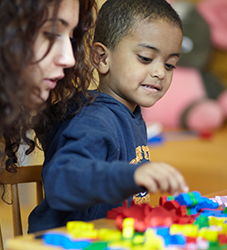
The project FIRST STEPS is an early prevention project for families with an immigrant background aiming to sustainably support social integration of toddlers (0-3) .
FLINK
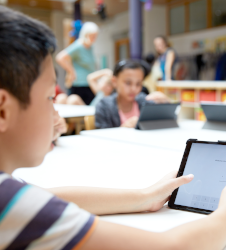
The FLINK project is investigating a computer-based fluency training programme. Children in the middle and lower reading achievement range in grades 2 to 6 can complete up to 54 training units in one school year. The training is accompanied by regular progress diagnostics and can be completed largely independently.

FLORI
The project FLORI focused on promoting reading fluency development in elementary school children.
GeKiSch
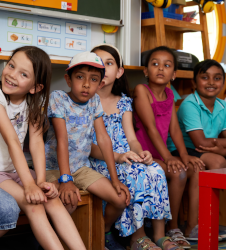
This project analyses the importance of low-threshold schooling and learning opportunities in initial reception centres in Hesse for the development, learning and integration process of children and adolescents. The aim is to identify the psychosocial needs of children in the developmental phase of school age and ultimately the challenges for educational practice in the school context and to formulate recommendations for policy and practice.

GUIDEPREP
The Europe-wide project ‘Growing Up in Digital Europe’ (GUIDE) analyses the success factors for the development of well-being in a digital world. Over a period of about 25 years, two birth cohorts (infants and school-age children) and their parents will be systematically surveyed. The upstream project GUIDEPREP (‘GUIDE Preparatory Phase’) will develop the necessary research infrastructure for the GUIDE panel between 2022 and 2026.
Hector
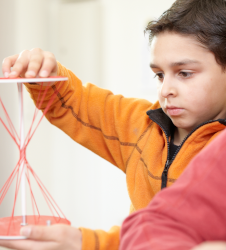
Hector Children’s Academies are extracurricular institutions that offer support to gifted children under the age of ten; they endorse a holistic approach. The aim of the project is a scientific monitoring of the support program. This includes the support of the implementation, the evaluation of the courses offered and the investigation of related scientific questions.

IGEL
The project IGEL aims at evaluating three different teaching approaches (scaffolding instructional discourse, formative assessment, and peer-assisted learning) in primary school science education.
iLearn
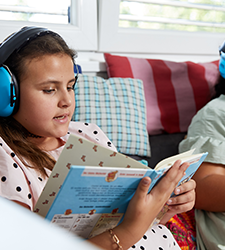
This project evaluates the potential of computerized formative assessment to support reading acquisition of children with reading difficulties. Formative assessment enables teachers to adapt their teaching methods to the individual learning progress of their students.

InSe
This project investigates the extent to which tests and test items are capable of capturing effects of instruction.