Projects
Individual Development
To the project browser
EÜLE
In the EÜLE project, we study which aspects of children’s self-regulation before they start school predict how they are doing by the end of first grade. We focus on self-regulation strategies and their school performance.

SeLFi-Panel-Study
The SeLFI Panel Study examines the development of self-regulation among students in grades 1 to 10. It focuses on links with reading and mathematics skills as well as mental health. In the long term, the study aims to provide instruments and normative data to support teachers in assessing self-regulation.

ProFix
Some students read literary texts as if they were expository texts: limiting themselves to extracting bits of information, without immersing themselves into textworlds or responding affectively or aesthetically to the texts. We call this a “limitation to the propositional textbase”. In our ProFix study, we are working with 400 students from Germany and Switzerland and try to understand who is afflicted by this phenomenon.

FLINK-SRL
FLINK-SRL extends the digital reading intervention FLINK by integrating self-regulation prompts. The project aims to support students in planning, monitoring, and reflecting on their learning process. By fostering deeper engagement with the learning materials, FLINK-SRL seeks to enhance the overall effectiveness of the intervention.

NEPCO
Children have difficulty understanding negation until around the age of five or six, and even adults process negative sentences less efficiently than affirmative ones. This project investigates whether these difficulties are related to the development of children’s cognitive abilities. To address this question, German-speaking children aged four to ten years and adult control participants will be tested using comprehension tasks, sentence-completion tasks, and eye-tracking experiments.
SprachFit
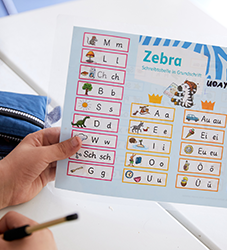
The acquisition of language skills is essential for overall child development. The “SprachFit” initiative aims to identify language deficits in children at an early stage and provide targeted support. The accompanying scientific evaluation study examines the implementation of the initiative and its impact on child development.
MultiDynAssess-India
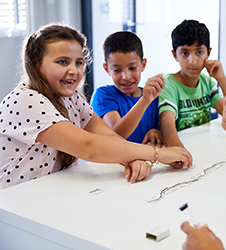
The project designs, implements, and evaluates multilingual dynamic assessment (DA) in Indian primary government schools where English is taught in a context characterised by high sociolinguistic diversity and widespread code-mixing practices. It investigates how multilingual versus English-only DA affects Grade 4 students’ language and content learning over time, drawing on classroom observations and a longitudinal comparison with traditional static assessment in schools in New Delhi and Guwahati. By aligning assessment with learners’ full linguistic repertoires, the project aims to promote equity in education and offers implications for multilingual assessment practices in India and other linguistically diverse contexts in the Global South.

ELF int.
The project ELF int. aims to analyze the procedure for estimating length with a view to accuracy in an international comparison.
MaLeLiOS
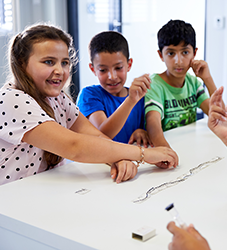
The MaLeLiOS project aims to investigate how narratively designed mathematical learning situations encourage children to engage in mathematical conversations and thus enable them to listen and observe on the one hand and to talk about mathematics and mathematical activities on the other.

Stereo-Disk
The project analyses the significance of stereotypes for the quality of support-related diagnostics in the inclusive school context and develops support formats that reduce their influence.