Projects
Adaptive Education
To the project browser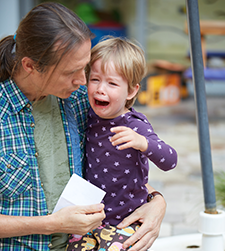
ELSE 3-6
Within the framework of ELSE 3–6, a digital evidence-based parenting programme is developed, implemented and accompanied by ongoing research. The programme provides parents with knowledge and practical strategies to support socio-emotional development in children aged 3–6, including emotions, emotion regulation, social skills, and coping with challenges.
KinAut
The KinAut project investigates the barriers and conditions for the successful participation of children with autism in the day-to-day life of childcare centres. The aim is to develop materials that incorporate different perspectives and are both evidence-based and practical, with a view to promoting inclusive and autism-sensitive early years education. The materials developed will be trialled and evaluated in collaboration with childcare centres in Frankfurt.
BRISE-Interaction Quality
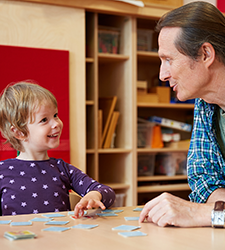
The sub-project “BRISE Interaction Quality” examines how support from the family and preschools affects children’s development.
SprachFit
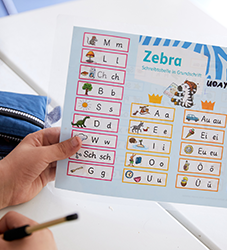
The acquisition of language skills is essential for overall child development. The “SprachFit” initiative aims to identify language deficits in children at an early stage and provide targeted support. The accompanying scientific evaluation study examines the implementation of the initiative and its impact on child development.
CatMo – Arena
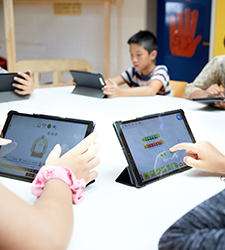
Category learning tasks are experimental paradigms used to study how humans acquire and apply categorical knowledge. Participants learn to classify multi-feature stimuli into categories without being explicitly told the underlying rules. Performance in these tasks provides insight into processes of generalization, abstraction, and memory.
BRISE-School Readiness
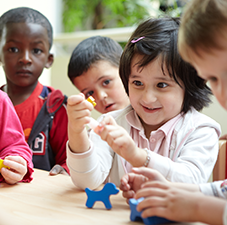
The sub-project of the second project phase (2025–2029) at DIPF is dedicated to the effects of the early childhood support chain on the development of basic skills in reading, spelling and arithmetic over the course of the primary school years.

Wurmloch
The idea of the ‘wormhole’ is often used in science fiction to visualise different dimensions of a plot.
In this pilot study with pre-school and primary school children, we try to transfer this idea to the development of knowledge of meaning.
For example, how do environmental changes relate to the development of semantic knowledge?
Vari
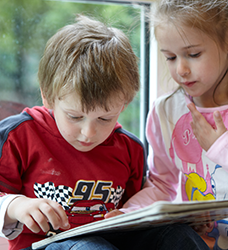
This project investigates how preschool children cope with linguistic variation. The focus is on the acquisition of adjectives such as big, clean or yellow. The project thus contributes to the question of how children acquire the grammatical rules of their first language and the meaning of utterances when the linguistic input is ambiguous.

SEM
The SEM project, funded within the framework of the BMBF funding guideline ‘Language Education in the Immigration Society’, aims to develop, test and research a concept for language support in pre-primary classes. The project includes subject-integrated language support in the development of mathematical precursor skills in conjunction with the promotion of emotional understanding and emotion regulation, as well as a language support related professionalisation programme for teachers working in pre-school classes.
SelKi
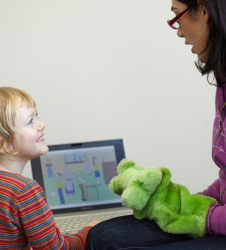
Self-regulation is an important prerequisite and a good predictor of later school performance, social-emotional development and mental health. However, there is no psychometrically validated test battery for measuring self-regulation in German-speaking countries. The aim of the project is therefore to develop, psychometrically test and standardise such a test battery.