Projects
Individual Development
To the project browser
NEDIK
Children, like adults, often have difficulty processing linguistic negation. However, these difficulties can be reduced or even eliminated when negation is presented in an appropriate context. Our project therefore examines how different contextual factors affect children’s processing and production of negation, with the aim of identifying the specific factors that facilitate these processes.
KinAut
The KinAut project investigates the barriers and conditions for the successful participation of children with autism in the day-to-day life of childcare centres. The aim is to develop materials that incorporate different perspectives and are both evidence-based and practical, with a view to promoting inclusive and autism-sensitive early years education. The materials developed will be trialled and evaluated in collaboration with childcare centres in Frankfurt.

CA:PPA-LAS
The project CA:PPA-LAS investigates how lower-achieving students in heterogeneous primary school classrooms can be specifically cognitively activated and supported in engaging in deeper thinking. We systematically examine the practical knowledge of primary school teachers and link it to existing theoretical conceptualizations of cognitive activation. Based on these findings, the project aims to develop practice-oriented recommendations and workshops that support teachers in designing adaptive, cognitively activating instruction.

FLINK-SRL
FLINK-SRL extends the digital reading intervention FLINK by integrating self-regulation prompts. The project aims to support students in planning, monitoring, and reflecting on their learning process. By fostering deeper engagement with the learning materials, FLINK-SRL seeks to enhance the overall effectiveness of the intervention.

ReKi
Resilience represents a theoretically important factor in talent development. We investigate this relation by using a diary study in which (particularly gifted) primary school children report how they experience stress and how they cope with it.

NEPCO
Children have difficulty understanding negation until around the age of five or six, and even adults process negative sentences less efficiently than affirmative ones. This project investigates whether these difficulties are related to the development of children’s cognitive abilities. To address this question, German-speaking children aged four to ten years and adult control participants will be tested using comprehension tasks, sentence-completion tasks, and eye-tracking experiments.
VULKAN
The project examines the reading behaviour of 14- and 15-year-olds who read a side-by-side display of a reading edition of Kleist’s work and a plain-language version created specifically for this project. The study aims to determine how the students read the text, for example, whether they use the option to switch between the reading edition and the simplified version, thereby reading the texts in comparison.

Ko-divers
The Ko-divers project aims to develop through an evaluation-based process, a practical, effective and diversity-sensitive teaching concept for cooperative learning using the design-based research approach within research-practice partnerships.

BRISE-Interaction Quality
The sub-project “BRISE Interaction Quality” examines how support from the family and preschools affects children’s development.
SprachFit
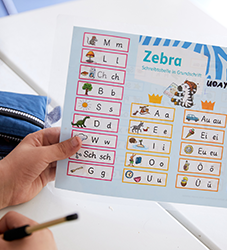
The acquisition of language skills is essential for overall child development. The “SprachFit” initiative aims to identify language deficits in children at an early stage and provide targeted support. The accompanying scientific evaluation study examines the implementation of the initiative and its impact on child development.