Projects
Professionalization
To the project browser
Startchancen SRL
As part of the scientific research accompanying the Startchancen programme, we are investigating how self-regulated learning can be promoted – especially among children from socially disadvantaged backgrounds.
MultiDynAssess-India
The project designs, implements, and evaluates multilingual dynamic assessment (DA) in Indian primary government schools where English is taught in a context characterised by high sociolinguistic diversity and widespread code-mixing practices. It investigates how multilingual versus English-only DA affects Grade 4 students’ language and content learning over time, drawing on classroom observations and a longitudinal comparison with traditional static assessment in schools in New Delhi and Guwahati. By aligning assessment with learners’ full linguistic repertoires, the project aims to promote equity in education and offers implications for multilingual assessment practices in India and other linguistically diverse contexts in the Global South.
MultiDiskurs
The project aims to account for patterns of variation in the processing of linguistic structures in discourse. In particular, we investigate how bilingual children ranging in age from 8 to 12 integrate morphosyntactic and discourse information, for example by using eye-tracking experiments. Among the factors that contribute to individual variation, we explore the role of cross-linguistic influence, differences in bilingual profiles in terms of language and literacy exposure, individual cognitive skills and bilinguals’ ability to share discourse strategies across their two languages.
PRISMA
Working memory is central to school learning and is shaped by teacher–child relationships. Previous research has mainly focused on differences between children, although performance and relationships also vary substantially within the same child. Our project examines how these daily fluctuations affect short-term learning and long-term developmental pathways.
TeWiPrax
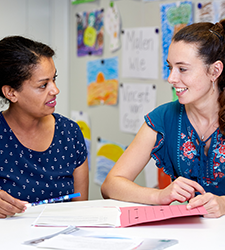
In the TeWiPrax project, researchers and teachers from the group „Sprachförderung/Mehrsprachigkeit“ of the “Campusschulen” program collaboratively develop and test materials that support secondary school students in understanding scientific texts. A particular focus is on academic and subject-specific vocabulary.
BRISE-School Readiness
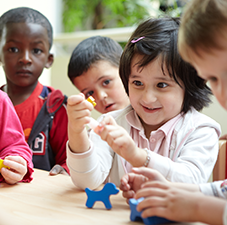
The sub-project of the second project phase (2025–2029) at DIPF is dedicated to the effects of the early childhood support chain on the development of basic skills in reading, spelling and arithmetic over the course of the primary school years.
Young Children’s Worlds
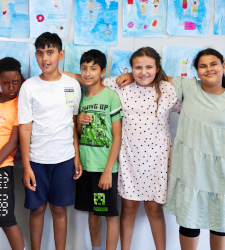
This project will develop a questionnaire to quantitatively assess the well-being of children between the ages of 6 and 8. The study will be conducted in parallel in South Africa and Israel.

VokSi
Vocabulary learning is easier when the learner is active, either by making a prediction about the possible translation of the foreign word, or by making gestures at the same time. The aim of this project was to investigate these learning activities in more detail and to look more closely at the effects of their interaction.

TAM
The aim is to investigate the developmental trajectories of cognitive and motor adaptation across childhood, adolescence, young adulthood and old age. We have developed a new task that has proven to be appropriate and sensitive for investigating developmental and individual differences within specific age groups.
Stereo-no-GO
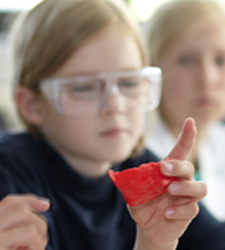
The Stereo-no-GO project investigates gender and background inequalities in STEM and participation in gifted education programmes.