Projects
CHAT2TRANSITION
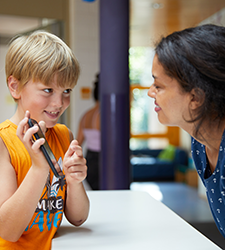
The project examines the emergence and consequences of educational decisions at the transition from primary to secondary school. It focuses on improving the information available to families and teachers. A multilingual chat assistant for families and a reflection program for teachers aim to reduce social and migration-related inequalities in educational outcomes.

Children’s Worlds
An international study of material, social, and cultural conditions of a good life and opportunities of education and participation from children’s and youth’s point of view.

CLaB
This interdisciplinary research project investigates systematically Child Language Brokering (CLB) – informal translation practices by multilingual students – in German-speaking schools. Three sub-studies explore children’s and teachers’ perspectives on CLB, its interactional patterns, and its educational potential. The aim is to collaboratively develop approaches to translingual didactics and make them applicable to everyday school practice.
COINS
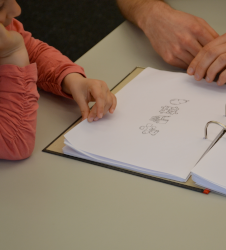
The aim of the COINS project is to identify key features of instruction-sensitive test items that can be taken into account in the development of standardised performance tests.
DaZ ab 6
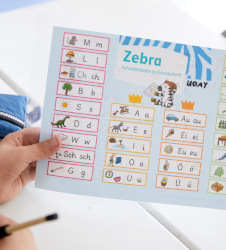
Die Rolle des expliziten Sprachwissens für den Deutscherwerb bei SeiteneinsteigerInnen an Schulen und bei geflüchteten jungen Erwachsenen
DAZHOCHZWEI
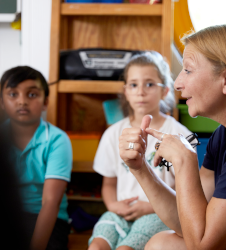
The project DAZHOCHZWEI is a cooperation between the Professorship for German as a Second Language (Goethe University, Prof. Dr. Petra Schulz), the Ministry of Education, Hesse, and the Teacher Academy, Hesse. DAZHOCHZWEI aims at implementing a linguistically based language training for children into the (continuing) education program for primary school teachers in Hesse. The project […]

DELTA
In the project DELTA we apply a working memory training with elementary school children. We investigate the impact of children’s daily experiences on training success, with a focus on motivation, well-being, and sleep on training days.

DERET
Qualitative and quantitative analysis of errors in spelling, to allow different levels of analyses for a heterogeneous population of users.

DeSign
Self-regulation refers to an individual’s ability to control his or her own thoughts, feelings and actions in a way that supports the pursuit of long-term goals. The characteristics of situations influence this ability and can therefore support or hinder self-regulation. The DeSign project investigated the interplay between the perceived quality of teaching during a lesson and changes in students’ self-regulation.

DIALOG
The DIALOG project accompanies a 1.5-year training programme on the implementation of discovery and inquiry-based learning for early childhood educators. Various methods (e.g. video observations and smartphone-based surveys) will be used to investigate the interaction and communication between the actors and the conditions for successful implementation of the programme content.