Projects
Adaptive Education
This domain focuses on learning arrangements in kindergarten, school, and informal educational settings.
To the project browser
KinAut
The KinAut project investigates the barriers and conditions for the successful participation of children with autism in the day-to-day life of childcare centres. The aim is to develop materials that incorporate different perspectives and are both evidence-based and practical, with a view to promoting inclusive and autism-sensitive early years education. The materials developed will be trialled and evaluated in collaboration with childcare centres in Frankfurt.

Ko-divers
The Ko-divers project aims to develop through an evaluation-based process, a practical, effective and diversity-sensitive teaching concept for cooperative learning using the design-based research approach within research-practice partnerships.

LeA-Training
The focus of project LeA-Training is to investigate a reading fluency training program. The project aims at identifying the underlying mechanisms resulting in reading improvement to effectively implement the training for children with reading difficulties.

LexPro Training
The project focuses on the enhancement of visual word processing in children with reading problems (5th and 6th graders).

LONDI (former OnDiFoe)
The project LONDI aims at developing a web-based platform to support the identification and treatment of children with major difficulties in learning to read, spell, and/or calculate. The platform will provide evidence-based information, materials and tools for learning disabilities screening as well as for the individual diagnosis and remediation.

LONDI 2
LONDI is an online platform for the diagnosis and support of children with learning disabilities. The collaborative project LONDI 2 is investigating how the online platform can be used and evaluating this process. The aim is to disseminate the platform widely and enable its effective and sustainable use, particularly in primary schools, but also in therapy and by parents.
MaLeLiOS
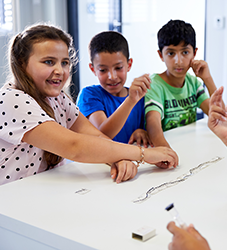
The MaLeLiOS project aims to investigate how narratively designed mathematical learning situations encourage children to engage in mathematical conversations and thus enable them to listen and observe on the one hand and to talk about mathematics and mathematical activities on the other.

MatheMat
The MatheMat project examines learners’ actions on comparable digital and analogue materials in order to reconstruct the mathematical interpretations underlying these actions. The question is what mathematical interpretations learners make of comparable digital and analogue mathematical situations and whether differences can be observed that are caused by the material. Based on the results of the project’s analyses, recommendations will be made for the use of digital and analogue materials in mathematical learning situations.

MeBis
MeBis is a project examining the handling of and attitudes towards multilingualism in children, parents and teachers in primary education settings, particularly concerning the use of several languages, for learning at home and reading out to children, but also during lessons with a particular focus on grammar and language comparisons.
meRLe
The meRLe project explores ways to promote German reading skills using multilingual-sensitive reciprocal teaching in primary education.